The Power of Alcohol-Free
Do beer drinkers really attract mosquitoes?

By Anthony
To begin
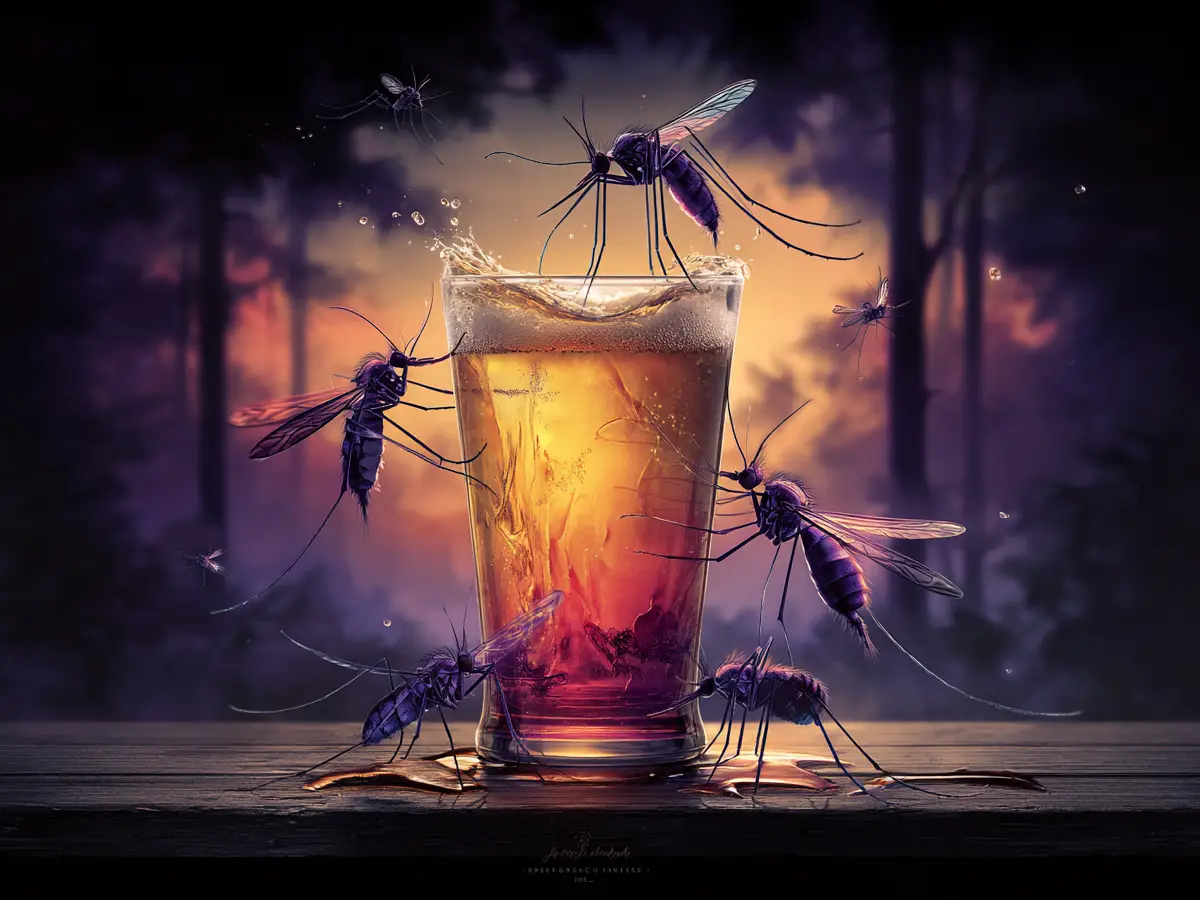
In summer, mosquitoes are the unwelcome guests at all our outdoor gatherings. A rumour has long circulated that drinking beer makes you more attractive to these insects—a notion often shared as an anecdote or even an urban legend, yet rarely scientifically proven. In 2023, Dutch researchers took advantage of a major festival to put this surprising claim to a scientific test. Their findings now provide solid answers... and raise an unexpected question: might non-alcoholic beer avoid this phenomenon?
A study of unprecedented scale
The setting: a Dutch festival transformed into a laboratory
In August 2023, a research team led by Dr. Felix Hol at Radboud University (Nijmegen, Netherlands) used the Lowlands festival as the venue for a unique experiment. More than 465 volunteers took part in an experimental setup installed directly on-site. The researchers converted shipping containers into temporary laboratories, making it possible to test mosquito attraction in a semi-natural yet controlled environment.
Key findings
The data collected and published as a preprint in 2025 show that festival-goers who had consumed beer in the preceding 12 hours were, on average, 35% more attractive to mosquitoes than those who had abstained. This statistically robust figure confirms a popular intuition while aligning with previous studies: a study published in Japan in 2002 and another conducted in Burkina Faso in 2010 had already yielded similar results.
The scientific mechanisms involved
Biological pathways
While researchers confirm that beer increases attractiveness to mosquitoes, they emphasise that the phenomenon is not linked to ethanol itself, but rather to the effects it has on the body. Several mechanisms are suggested:
- Alteration of body odour: alcohol consumption changes the chemical composition of volatile compounds emitted by the skin.
- Increased body heat: alcohol causes blood vessels to dilate, making the skin slightly warmer and thus more detectable to mosquitoes.
- Increased carbon dioxide (CO₂) emission: by affecting respiration, alcohol can increase the amount of CO₂ exhaled—a powerful signal for mosquitoes.
- Influence on the skin microbiota: alcohol may alter the skin's bacterial composition, thereby affecting the production of odour-producing substances that attract insects.
Key molecules identified
Recent research into the chemistry of human-mosquito interactions highlights several compounds that play a major role:
- Lactic acid, the primary human attractant produced by skin bacteria.
- Carboxylic acids, directly associated with attractiveness.
- Ammonia, which acts in synergy with CO₂.
- Short-chain volatile fatty acids, which enhance the effect of lactic acid.
These results confirm that mosquito attraction relies on a complex mix of chemical, thermal, and respiratory signals, rather than a single isolated factor.
Other attraction factors revealed
Hygiene and behaviours
The Dutch study was not limited to beer; it also analysed a wide range of lifestyle habits. The results are sometimes surprising:
- Showering, for instance, significantly reduces attractiveness: freshly washed volunteers were bitten about 50% less.
- Sharing a bed the previous night had the opposite effect, increasing attractiveness by approximately 34%. Researchers suggest that this proximity might alter a person’s scent profile, either through the transfer of body odours or because sharing a bed influences sweating and the production of skin compounds.
- Sunscreen proved to be protective: applying it reduces the likelihood of attracting mosquitoes, although the mechanism behind this is not yet fully understood.
- And finally, a modest correlation with cannabis use was observed, but this effect disappears once other factors are controlled for.
Genetic influence and individual variability
Beyond behaviour, research reminds us that attractiveness to mosquitoes also depends on biological factors that are difficult to control.
- Some individuals possess specific genes (notably certain alleles of the HLA system) that influence the composition of body odours.
- The skin microbiota also plays a major role: recent studies have shown that the bacterial diversity of the skin directly determines the production of attractive chemical compounds.
These factors explain why, in the same environment, some people always seem to be "spared" while others become prime targets for mosquitoes.
Scientific limitations and caveats
Population selection bias
The researchers themselves point out that their study relies on a very specific sample: young, healthy adults attending a music festival. This population does not necessarily reflect the diversity in age, health status, or consumption habits found in the general population.
An imperfectly controlled environment
Although the experimental setup was ingenious, it remains far removed from laboratory conditions. Participants had consumed various foods, hygiene products, or recreational substances that were difficult to isolate statistically. These confounding variables limit the scope of the conclusions.
The need for validation by further studies
Dr. Hol and his team therefore recommend caution: the results are robust but need to be confirmed in more diverse contexts, using representative samples and more standardised environments.
Wine vs. beer: what do the data say?
Results from the Lowlands festival show a signal for beer (+35% attractiveness on average), but not for wine in this cohort, and no linear relationship with blood alcohol levels. In other words, it is likely not the ethanol "per se," but a combination of indirect effects linked to the "beer drinker" profile (behaviours, perspiration/CO₂, skin temperature, microbiota/odours) that explains the observed increase.
The researchers emphasise that it is not ethanol itself that attracts mosquitoes, but a set of mechanisms that are not yet fully understood. Wine—which has a higher alcohol content but is often consumed in more static settings (accompanied by food)—showed no significant effect.
Non-alcoholic beer: an alternative... worth testing?
Non-alcoholic beer was not directly tested in the studies, but it can reasonably be assumed that it reduces certain indirect factors associated with regular beer consumption (such as sweating or increased CO₂). However, this remains a hypothesis: to date, there is no scientific data on the specific effect of non-alcoholic beer regarding mosquitoes.
The common belief that beer attracts mosquitoes has been confirmed: a Dutch study conducted at the 2023 Lowlands festival showed a roughly 35% increase in attractiveness among beer drinkers. Yet, the results also highlight a key point: ethanol is not directly responsible. Wine, despite having a higher alcohol content, does not produce the same effect.
The mechanisms appear to be linked to a complex set of factors: specific compounds derived from the beer, changes to the skin microbiota, alterations in body odour, and perhaps behaviours associated with consumption.
In practical terms, this means that drinking beer slightly increases the risk of being bitten, though the effect remains moderate and depends on other, more significant variables: hygiene (showering), sunscreen use, genetics, and the environment. As for non-alcoholic beer, it has not yet been directly studied; drawing a firm conclusion is therefore difficult, even though it might logically reduce certain indirect effects.
Further research is needed to precisely identify the molecules involved. However, one thing is already certain: mosquitoes and beer do indeed make for a combination that leaves its mark.