The Power of Alcohol-Free
Drinking to live to 100: the Okinawa report

By Anthony
To begin
Located over 1,500 kilometres south of Tokyo, Okinawa fascinates the entire world. This small subtropical island—often dubbed the "Island of Longevity"—is home to three times as many centenarians as the global average; in villages like Ogimi, there are as many as five centenarians for every 1,000 inhabitants. Since the 1970s, doctors and researchers have been studying this unique phenomenon. According to Dr. Suzuki’s team, a significant portion of this longevity is linked to environmental factors, lifestyle, and diet—though the exact breakdown remains uncertain (scientific literature suggests that roughly 25% of the variation in longevity is genetic, while 75% is linked to lifestyle and environment).
While the famous "Okinawa diet" is frequently discussed, a more subtle element also draws attention: the beverages. Jasmine or medicinal herbal teas, naturally mineral-rich waters, fermented concoctions... these liquid rituals constitute a veritable daily pharmacopoeia. But do these drinks truly explain Okinawan longevity, or are they merely a reflection of a broader lifestyle?
The fundamentals: hydration, moderation, and sociability
Before even discussing fragrant teas or unique mineral waters, one must understand the Okinawan relationship with beverages. Here, people do not drink merely to quench their thirst, but also to cultivate health and social bonds.
A key principle underpins this approach: "hara hachi bu." Literally, this means "80% full stomach." Okinawa’s centenarians stop eating—and drinking—before reaching the point of feeling completely full. This seemingly simple practice limits excess calorie intake and promotes lighter digestion. It also helps maintain a steady fluid balance without overburdening the body.
However, beverages are not merely a personal matter; they are deeply intertwined with communal life. Within the traditional moai system—groups of friends who provide lifelong mutual support— sharing a cup of tea or a bowl of fermented drink is a daily ritual. These moments foster a sense of belonging, reduce stress, and strengthen the social safety net—factors now recognised as crucial for longevity.
In short, even before considering the biochemical composition of the teas or waters, the Okinawan secret lies in a subtle balance: drinking regularly, in moderation, and—above all—together.
Sanpin-cha: the signature drink of centenarians
An infusion that is a staple of daily life
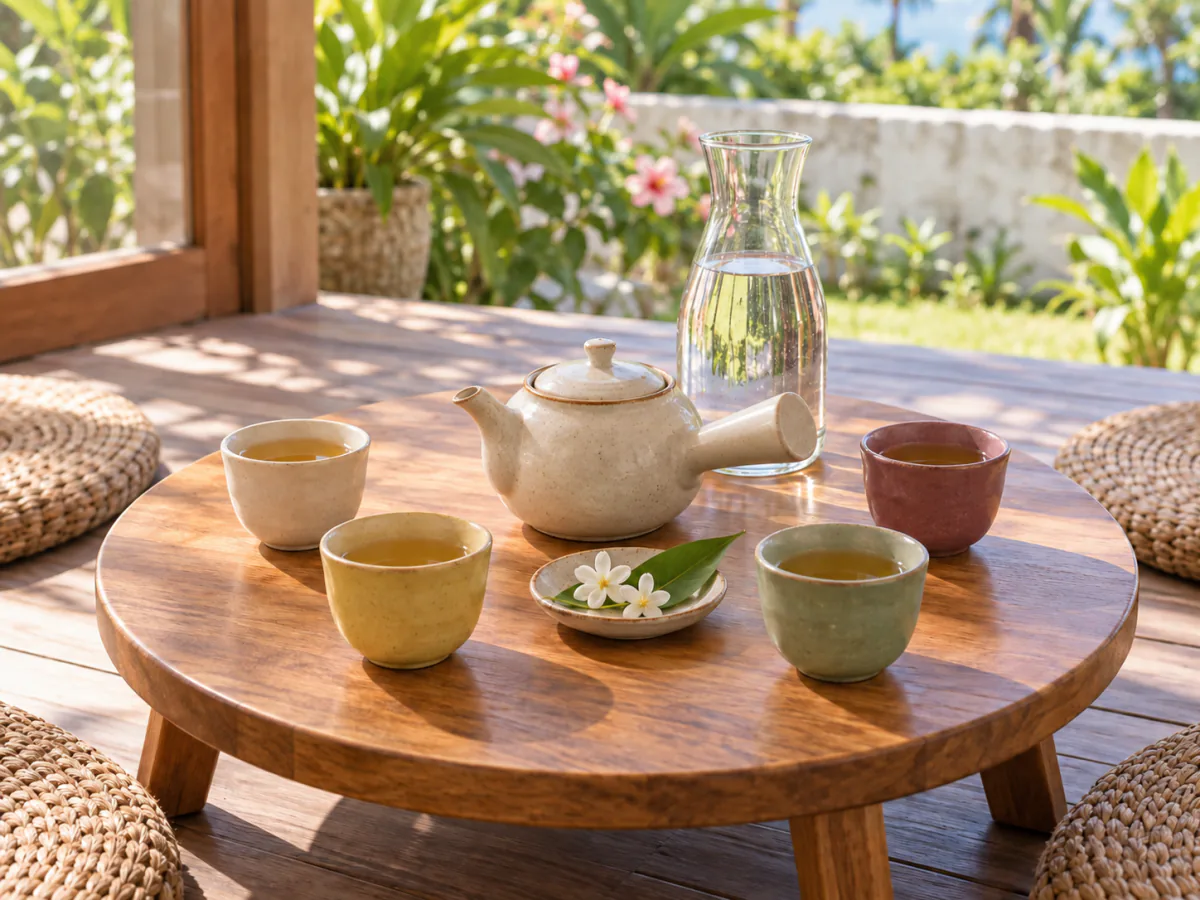
In Okinawa, it is hard to miss Sanpin-cha (さんぴん茶). This jasmine tea —slightly different from classic Japanese green tea—is made from lightly fermented Chinese tea leaves scented with jasmine blossoms. Served hot or cold, it accompanies meals, family conversations, and even work breaks. It is found in homes and restaurants alike, as well as in convenience stores (konbini) and even vending machines.
Sanpin-cha is a staple of daily life, offering a blend of refreshment and calm.
Benefits backed by research
The benefits of Sanpin-cha are not based solely on tradition. A case-control study conducted between 1988 and 1991, involving 333 cases and 666 controls, revealed a significant correlation between the consumption of Okinawa tea and a reduced risk of lung cancer. The results are particularly striking among women: those who consumed 10 or more cups a day saw their risk reduced by 62% compared to non-daily consumers.
Researchers attribute these effects to catechins and EGCG (epigallocatechin gallate), powerful antioxidants found in Sanpin-cha. They help to:
- reduce cardiovascular risks,
- lower the risk of certain cancers,
- improve metabolic regulation,
- provide a gentle stimulating effect, without excessive caffeine.
How can it be adapted for France?
To reap the benefits of this habit, there is no need to match the 10 cups a day consumed by Okinawan centenarians. Drinking 3 to 5 cups daily is a realistic and beneficial practice, which can be adjusted based on your caffeine tolerance. In France, you can find jasmine green tea—either loose-leaf or in bags— at most Asian grocery stores and organic shops.
Handy tip: preparing a teapot in the morning and steeping the same leaves multiple times for short periods allows you to enjoy delicate flavours without excessive bitterness, while staying hydrated throughout the day. Served chilled with a bit of citrus zest, Sanpin-cha also makes an excellent 0.0% alternative to commercial sodas.
Mineral-rich water: the geological foundation of longevity
Unique water shaped by coral reefs
The island of Okinawa rests on ancient fossilised coral reefs. As it filters through these limestone formations, rainwater becomes enriched with calcium and magnesium in an optimal 2:1 ratio, as well as dozens of trace elements in ionised form. The result is "hard" water with exceptional mineral content, quite different from the soft water found in other regions of Japan.
Link to longevity
The recent data from the Amami Islands—geologically close to Okinawa—show a strong correlation between water hardness and the proportion of centenarians: nearly 30 per 10,000 inhabitants in hard-water areas, compared to fewer than 12 in soft-water areas. While this observation does not prove direct causation, it confirms the probable role of mineralisation in preventing chronic diseases.
The protective mechanisms of calcium and magnesium
The mineral richness of this water offers several known benefits:
- Blood pressure regulation thanks to magnesium, which promotes vasodilation.
- Reduced cardiovascular risk: magnesium prevents the excessive accumulation of calcium in the arteries.
- Maintenance of stable heart function and efficient nerve conduction.
- Enhanced bone health, with calcium contributing to mineralisation while magnesium optimises its absorption.
In short, drinking this mineral-rich water helps maintain lower blood pressure, a healthy heart, and strong bones —three pillars of the longevity observed in Okinawa.
How to apply this in France
There is no need to import "coral water": several French mineral waters offer a comparable profile. Brands such as Hépar, Contrex, Courmayeur, and Velleminfroy offer high levels of calcium (≥150 mg/L) and magnesium (≥50 mg/L), close to the levels found in Okinawa’s water. Incorporating them into a daily routine makes it possible to replicate—locally—one of the hydration-related factors contributing to longevity.
Therapeutic teas: a liquid pharmacopoeia
Beyond Sanpin-cha, Okinawa is distinguished by a rich tradition of infusions made from local plants and spices from across Asia. These so-called "therapeutic" teas are part of a genuine functional approach to health, rooted in traditional pharmacopoeia and now partially validated by science.
Shell ginger tea (Alpinia zerumbet, sannin / gettou)
Shell ginger —known locally as sannin or gettou—is a tropical plant native to the Ryukyu Islands. Its leaves and flowers are used to prepare fragrant infusions with slightly spicy notes. Analyses reveal a polyphenol concentration 34 times higher than that of red wine, as well as unique compounds such as dihydro-5,6-dehydrokawain (DDK).
Animal studies indicate that Alpinia zerumbet can increase lifespan by more than 20%, by acting as a caloric restriction mimetic: activating sirtuins, stimulating autophagy, and providing cellular protection. Although these results need to be confirmed in humans, this plant is considered one of the phytotherapeutic pillars of Okinawan longevity.
Turmeric tea (ukchin)
Introduced to Okinawa via trade routes, turmeric has become deeply rooted in local culture. Brewed as a tea, it is prized for its anti-inflammatory properties and its role as a natural remedy for fatigue and hangovers. Its active compounds—notably curcumin —are better absorbed in the presence of black pepper or fats, yet remain beneficial even when brewed simply on its own.
Goya tea (bitter melon)
Goya, or bitter melon, is an iconic Okinawan vegetable. Rich in vitamin C and charantin, it is consumed both as a food and as a tea. Its pronounced bitterness is reputed to stimulate metabolism and regulate blood sugar levels, which may contribute to the low prevalence of diabetes historically observed among the island's inhabitants.
Adapting these teas for Europe
While shell ginger remains hard to find outside Japan, turmeric and dried goya (bitter melon) are available at select herbalists, Asian markets, and specialised online shops. For an accessible, alcohol-free option, you can prepare infusions blending turmeric, ginger, and citrus, or sweeten goya tea with a little honey to balance its bitterness.
Fermented drinks: the probiotic dimension
Okinawa’s longevity relies on another secret as well. Fermented drinks play a vital role in maintaining gut balance and fostering social connection among the locals. Rich in probiotics, they help maintain a diverse microbiota, now recognised as a key factor in overall health.
Miki: a traditional lacto-fermented drink
Made from rice, sweet potatoes, and sugar, miki is a mild, slightly thick drink with a texture similar to drinkable yoghurt. Traditionally prepared in households, it is still available commercially at markets in Okinawa. Its fermentation process produces lactic acids that benefit gut flora, contributing to better digestion and a strengthened immune system.
Tofuyo: a fermented tofu product
Tofuyo is an iconic food: tofu fermented in awamori (a local spirit) with red yeast. Beyond its rich, complex flavour, it provides bioactive compounds and fermented proteins. Animal studies have shown that tofuyo extract can extend lifespan, protect the stomach, and reduce cholesterol synthesis. More of a foodstuff than a mere beverage, its concentrated extract highlights the role of fermentation in the local diet.
Awamori: putting the spirit in context
Produced for over 600 years from long-grain rice, awamori is the traditional spirit of Okinawa. It is rarely consumed neat here; instead, it is diluted with water (often in equal parts), which lowers its alcohol content. Beyond the drink itself, awamori plays a central role in social rituals, particularly during moai gatherings—circles of friendship and mutual support. From a non-alcoholic perspective, it is entirely possible to maintain this ritual by preparing a local alternative: for instance, a sparkling Sanpin-cha highball with a twist of citrus, served in the same glasses, to preserve the convivial spirit while keeping the drink 0.0% alcohol.
Consumption data from centenarians
A distinctive nutritional profile
A baseline study conducted on 21 Okinawan centenarians living at home (17 women and 4 men) highlighted specific dietary and hydration habits. Compared to centenarians in the rest of Japan, those in Okinawa consumed:
- significantly more beverages in general, reflecting the importance of regular hydration in their lifestyle,
- less milk and dairy products, confirming a dietary tradition low in animal-based products,
- more green vegetables, rich in fibre, vitamins, and antioxidants,
- fewer sugary foods: only one-third of them expressed a preference for sweet flavours, compared to a much higher national average.
Lower blood pressure
Epidemiological data also reveal that Okinawan centenarians have lower diastolic blood pressure than the Japanese average. This characteristic is likely linked to their regular consumption of water rich in calcium and magnesium, as well as their modest dietary habits and moderate yet consistent physical activity.
Moderation and mindful eating
These observations fit into the broader context of the hara hachi bu principle—stopping eating and drinking when one reaches about 80% satiety. This mindful approach to beverages makes it possible to combine optimal hydration, moderate energy intake, and the prevention of excess.
In summary, Okinawan centenarians are also distinguished by their moderate, regular, and intentional approach to hydration.
Limitations and controversies
The question of supercentenarians
In 2019, a study cast doubt on the authenticity of the supercentenarians (people over the age of 110) recorded in the Blue Zones, including Okinawa. According to the authors, the lack of reliable civil registration records in the 19th and early 20th centuries may have led to age-related errors, exaggerating the number of individuals reaching extreme old age. However, these criticisms do not call into question the exceptional proportion of "classic" centenarians (aged 100 to 109), well-documented by Japanese demographic surveys.
The Westernisation of Lifestyle
Since World War II, Okinawa has experienced significant Westernisation of its diet and lifestyle. Consumption of processed foods, fatty meats, and sugary drinks has gradually increased, while traditional beverage habits (teas, herbal infusions, fermented drinks) have declined among younger generations. Consequently, Okinawans' relative life expectancy has fallen compared to the rest of Japan, highlighting the fragility of this cultural balance.
Scientific Caution
Most data regarding Okinawan beverages come from observational studies. These establish correlations but not strict causality. The observed benefits may be partly explained by associated factors: overall diet, physical activity, low smoking rates, and strong social networks. Furthermore, the tendency to highlight specific foods or drinks as "secrets" to longevity carries a risk of oversimplification, which is sometimes exploited by marketing.
In short, while Okinawan beverages play an undeniable role in local longevity, they should not be viewed as a miracle potion, but rather as one component of a lifestyle that is generally frugal, active, and socially rich.
Drawing inspiration from Okinawa in daily life
An "Okinawa-style" hydration routine
To benefit from the lessons of the "island of longevity"— without resorting to artificial imitation —you can adopt a simple routine:
- Jasmine green tea (Sanpin-cha): 3 to 5 cups a day, hot or cold, to enjoy the benefits of polyphenols and maintain steady hydration.
- Mineral-rich water (calcium and magnesium): alternate between waters such as Hépar, Contrex, Courmayeur, or Velleminfroy to supplement your mineral intake.
- Functional herbal infusions: opt for turmeric, ginger, or bitter melon (goya) for a variety of health benefits and flavours.
- Non-alcoholic fermented drinks: try homemade miki, or alternatives like water kefir or low-sugar kombucha.
- Mindful hydration: apply the principle of hara hachi bu by drinking regularly but without excess, and by savouring every moment.
The social aspect comes first
In Okinawa, drinking is not merely a physiological act; it is a social ritual. Sharing tea or miki with friends, family, or within a support group (moai) strengthens social ties and reduces stress. Replicating this ritual in France can involve alcohol-free aperitifs centred around iced infusions, tea-based mocktails, or shared kombuchas.
Precautions for use
Individuals suffering from kidney conditions or taking anticoagulant or antidiabetic medication should consult a professional before increasing their consumption of certain infusions (such as turmeric or bitter melon).
Highly mineralised waters can have a digestive effect (particularly those rich in magnesium, like Hépar); it is advisable to alternate with lighter waters depending on individual tolerance.
The key lies not in quantity, but in consistency and variety: a few glasses a day are enough to establish a beneficial routine.
The spirit rather than the letter
The true lesson from Okinawa lies not in a miracle drink, but in a philosophy of moderation, consistency, and conviviality. By incorporating these principles into our daily hydration habits, we can move closer to this model of longevity —adapted to our own cultural contexts and alcohol-free.
Okinawa’s centenarians did not discover a magic potion. Their exceptional longevity stems from a combination of factors: a frugal diet, regular physical activity, strong social ties... and a distinctive way of drinking. Jasmine teas, herbal infusions, mineral-rich waters, and fermented drinks make up a veritable liquid pharmacopoeia, integrated into a lifestyle of moderation and community.
For us in France, the point is not to replicate the practices of this subtropical island exactly, but to capture their spirit: prioritising simple, natural, non-alcoholic drinks; consuming them with moderation and regularity; and, above all, sharing them during moments of conviviality. Perhaps this is the true secret of Okinawa: longevity comes not just from what we drink, but from how we drink it—together.