Zero Pulse
French-washing fruit: what official controls actually show

By Anthony
To begin
A French origin claim carries weight, especially for fresh fruit. It also carries rules. For fruit and vegetables sold as such, the country of origin must be indicated; a voluntary reference to France must be justified and must not mislead consumers.
The evidence is more precise than the usual “massive fraud” headline. In its 2024 activity report, France's consumer protection and fraud control authority, the DGCCRF, says it carried out nearly 10,000 controls on food products presented as French, across sectors including fruit and vegetables, meat and alcohol. Thirty-four per cent of the controls showed an anomaly, leading to 1,802 warnings, 588 injunctions and 562 official reports. That is a control result, rather than proof that 34% of the whole food sector committed fraud.
Some individual fruit cases did lead to prosecutions and convictions.
What “French-washing” means
The DGCCRF's guidance on food origin distinguishes a required origin indication from voluntary claims such as a French flag or “Product of France”. For fruit and vegetables sold as agricultural produce, the country of origin is mandatory. Any origin reference must be truthful and must not create confusion.
Repackaging imported fruit in France does not make it French. The issue is the claim made to the buyer: an imported product presented as French can constitute a deceptive commercial practice or fraud on origin. The legal assessment belongs to the competent authorities and courts in each case.
From an imported consignment to a French-labelled punnet
The mechanism can be simple: the fruit stays the same, while its stated origin changes. A consignment enters the supply chain with purchasing documents. It may pass through a wholesaler, a packing facility and a shop. A false claim can appear on a label, package, invoice or sign displayed to a customer.
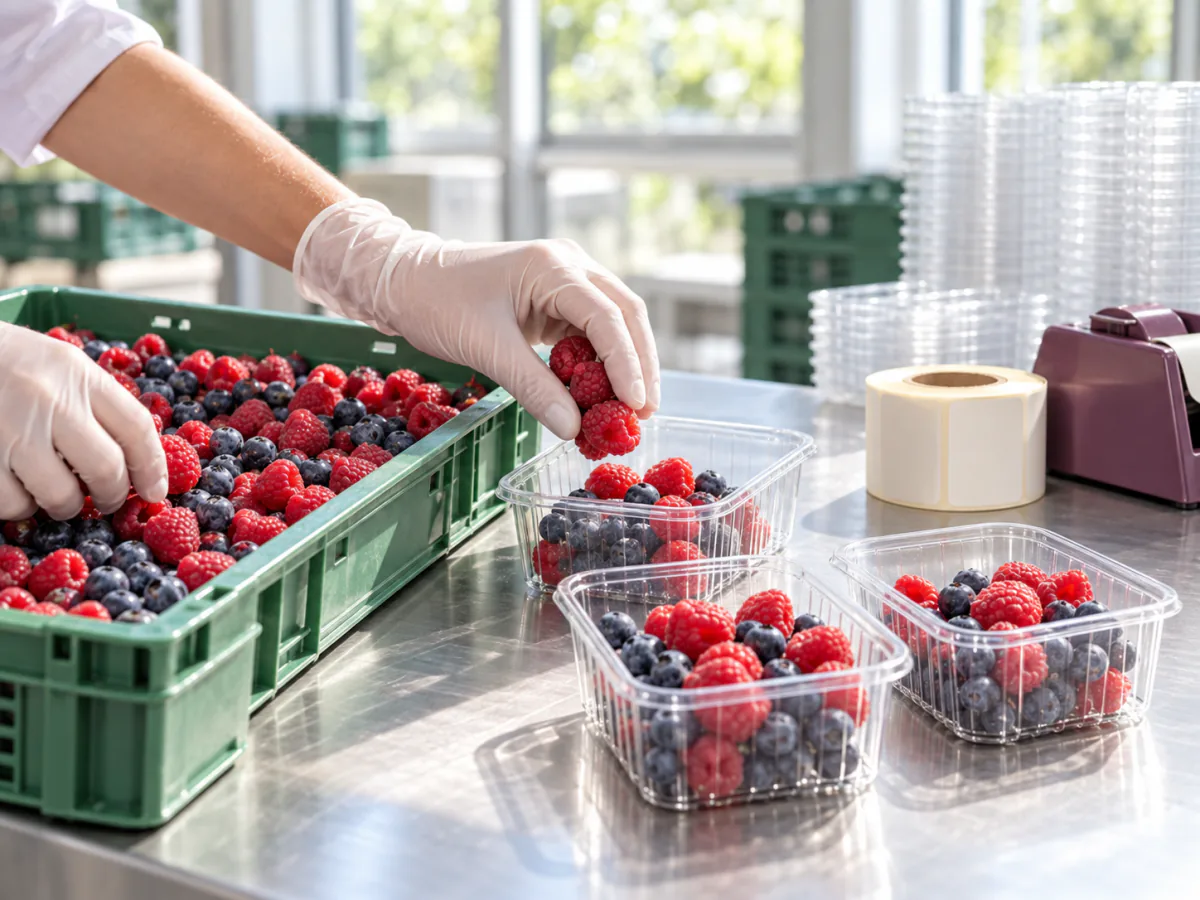
Separate the operations involved. Importing fruit, sorting it or putting it into punnets in France is part of normal trade. The deception arises when it is then presented as French despite the consignment's actual origin. A French packing address alone therefore does not tell you where the fruit was grown.
The route can be understood in four stages:
- Purchase: an operator receives fruit with a declared origin and quantity.
- Packing: packages may be opened, divided or combined. This can be entirely legitimate.
- Presentation for sale: the package, invoice or display carries the claim intended for the buyer. A false origin can be passed on at this stage.
- Consistency checks: documents and volumes should make it possible to trace the product behind the claim.
Intermediaries do not all play the same role in a case. A consignment's presence in a retailer's stores does not prove that the retailer organised the substitution. Investigators need to establish who bought, packed, labelled and sold it, using the corresponding documents.
What the 2024 controls show
The DGCCRF's 2024 activity report records nearly 10,000 controls on French-origin claims for food products. The campaign covered fruit and vegetables, meat and alcohol, and followed the supply chain when inspectors found indications requiring further investigation.
The reported 34% anomaly rate led to 1,802 warnings, 588 injunctions and 562 procès-verbaux, or formal official reports. “Anomaly” is the report's inspection terminology: it can cover non-compliant information or traceability, and does not mean every operator inspected was convicted of a criminal fraud. Nor does the rate establish prevalence across all fruit sold in France. The figures describe this campaign and its follow-up, rather than the entire agricultural sector.
Two documented fruit cases
In a DGCCRF notice published in 2025, the investigation into wholesaler Fruits rouges du Périgord established that 412 tonnes of foreign fruit had been sold as “French origin”. Marketed in 2020 and 2021, the products included raspberries, blueberries, redcurrants, blackberries, blackcurrants, chestnuts and kiwis imported mainly from Morocco, Portugal and the Netherlands, with some from Guatemala. Bergerac's criminal court sentenced the manager in June 2025 to a €50,000 fine and a one-year suspended prison sentence; the company's case had been referred to the prosecutor.
A separate case in Loir-et-Cher concerned conduct between 2019 and 2021. Investigators established false French-origin claims for 4,547 tonnes of strawberries, 278 tonnes of raspberries and 194 tonnes of blueberries sold to supermarkets and other large retailers. The judgment of 1 August 2024 fined the company €100,000 and its president €20,000.
A broader investigation, with limits at each stage
The DGCCRF's national 2020 investigation is useful because it describes its sample. In 2020, the authority carried out 826 inspection actions in 452 establishments. Non-compliance was found at nearly 30% of non-permanent retail outlets such as markets and fairs, 25% at retail level, 16% at production level and 5% among wholesalers. These rates concern the stages inspected, rather than the entire chain or proven fraud by every operator. There were 140 follow-up actions, including 20 official reports for fraud or deceptive commercial practices.
The same investigation explains why origin inquiries take time: inspectors may need to work back through accounts, invoices and traceability records, take samples for analysis, and cooperate with customs or other European authorities. Repacking can be legal; the false declaration of origin is what must be established.
What false origin takes away from growers and buyers
French origin can be a purchasing criterion for people who want to support particular growers, find produce from a specific place or shorten the distance from field to plate. A false claim redirects that choice. The buyer pays for a product that does not match the information given, whether its price is high or low.
For a grower selling their actual harvest, the issue is competition under the same origin claim. Imported fruit presented as French can compete with that harvest while benefiting improperly from the claim. The harm extends beyond a comparison of agricultural wages: it concerns fair dealing and trust in the label.
The DGCCRF notes that origin fraud takes markets away from honest operators and value away from the products concerned. The impact of a case on a particular farm or an entire sector still needs evidence: these fruit cases cannot establish a national loss of income, production or market share.
Imported fruit is not inherently poor-quality fruit. The issue is honest selling. Flavour, production conditions and origin are different pieces of information.
Origin claims, labels and consumer choice
The DGCCRF's food-origin guidance notes that France has 92 signs or certifications referring to a region or department, with differing specifications. AOP/PDO and IGP/PGI are protected European geographical designations with a defined link to a territory; a local-sounding phrase or reference to France does not automatically provide the same guarantee. Read the origin of the actual product even when a label is present.
Check the country of origin of fresh produce and question a claim that suggests French origin without a clear basis. If a specific display seems misleading, reporting it can help the authorities investigate. A suspicion is a report to examine, rather than a verdict.
Practical habits when choosing fruit
At a shop or market, look first for the fruit's country of origin, rather than a French address, brand name or tricolour design. If the display is ambiguous, ask where it was grown and whether the seller is the grower or a reseller.
Direct sales and short supply chains can make that conversation easier. They let you ask about the harvest, season and farm, while still requiring accurate information about each product. Equally, fruit sold early in the season or at a low price is not proof of fraud on those grounds alone.
Read labels for what they actually guarantee. A quality mark, organic certification and geographical indication have different purposes. When buying fruit for homemade drinks, distinguish variety, origin and production method rather than base the whole choice on one logo.
If a display appears misleading, retain the concrete details available: a photo of the label or sign, the product name, and the purchase date and location. France's public SignalConso platform accepts reports. This helps a case to be examined; it does not replace the authorities' checks or decision.
The response to French-washing rests on the same requirement throughout the chain: connect the claim to the product and the product to its documents. Accurate traceability protects both the buyer and the grower genuinely supplying the stated origin.
French-washing is established when investigators and courts show that imported fruit was sold under a false French-origin claim. Official figures also require care: an inspection anomaly is not automatically a criminal conviction, and a sample of inspected operators does not represent the entire fruit sector.
Useful responses combine precise traceability, honest origin information and documented controls. Read the label, understand what each designation covers and let established investigations carry the weight of the accusation.