Zero Pulse
Chimpanzees’ "daily pint" (and the origins of our taste for alcohol)

By Anthony
To begin
On September 17, 2025, a study published in the prestigious journal Science Advances came as a surprise: wild chimpanzees reportedly consume the alcohol equivalent of a pint of beer daily... without ever opening a bottle. Far from being a cultural habit, this intake comes naturally from the fermented fruit they devour in large quantities. This discovery, which confirms the famous "drunken monkey" theory, transforms our perspective on the origins of the human craving for alcohol and prompts us to question our own consumption habits.
An unsuspected daily intake
Researchers from the University of California, Berkeley, led by Aleksey Maro, analysed 21 fruit species consumed by chimpanzees at two iconic sites: Kibale National Park in Uganda and Taï National Park in Côte d’Ivoire. All the fruits studied contained ethanol, with an average concentration ranging from 0.26% to 0.3% by weight.
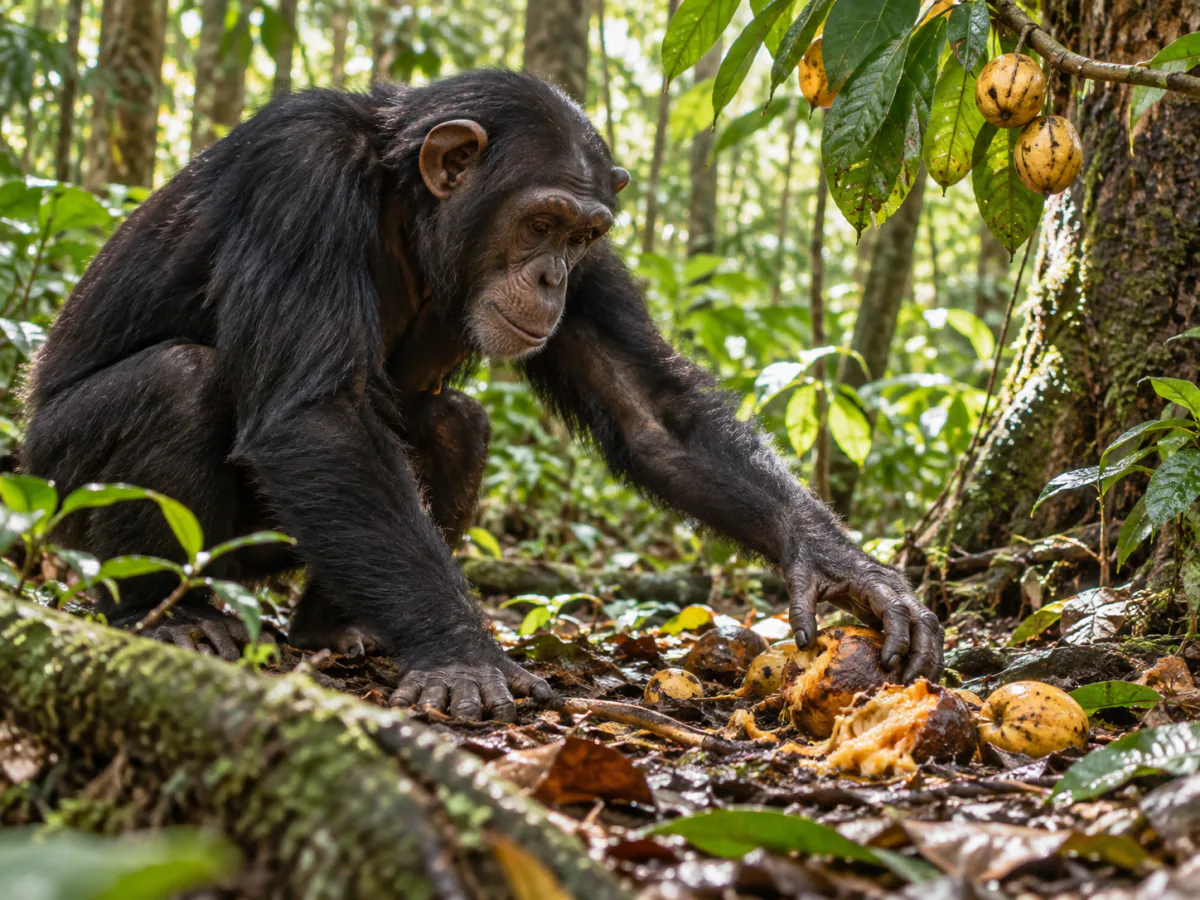
Each chimpanzee thus consumes between 4.5 and 6 kilograms of fruit per day, representing approximately 5% to 10% of its body weight. This represents a daily intake of 14 grams of pure ethanol —the equivalent for a human of a pint of lager. Despite this impressive volume, the primates studied show no signs of intoxication, as the alcohol is ingested gradually throughout the day, diluted in their diet.
Natural fermentation: a universal biological process
The presence of alcohol in the chimpanzees' diet is explained by a simple, universal process: spontaneous fermentation. When fruit falls to the ground and continues to ripen, yeasts naturally present on the surface convert the fruit's sugars into ethanol. The more advanced the fruit's stage of ripeness, the higher its alcohol content.
Field observations show that chimpanzees prefer the ripest fruits—those where fermentation is most advanced. This dietary choice is therefore likely significant. At low concentrations, ethanol does not make these animals drunk, but it could provide them with a chemical signal indicating a rich and immediately available energy source.
The "drunken monkey" theory finally validated
This discovery reinforces a long-controversial hypothesis: the “drunken monkey hypothesis”, formulated over a decade ago by biologist Robert Dudley, now a co-author of the study. According to him, humans' attraction to alcohol and their ability to metabolise it have their roots in primate evolution.
Around 10 million years ago, the ancestors of great apes had to adapt their diet in response to the shrinking of African forests. By consuming more fallen fruit, they were naturally exposed to ethanol produced by fermentation. This regular exposure likely selected for genetic tolerance to alcohol, a trait passed down to humans. The new study thus provides tangible confirmation of this intuition: our relationship with alcohol appears to be, at least in part, inherited from our distant evolutionary past.
Implications for the human species
The findings are unequivocal: chimpanzees—our closest cousins—ingest physiologically significant amounts of ethanol daily. This data sheds new light on our own relationship with alcohol. Our attraction to alcohol may stem not (solely!) from culture, but also from a biological legacy dating back millions of years.
For Nathaniel Dominy, a professor of anthropology and evolutionary biology at Dartmouth College, this study represents a "real tour de force." It raises novel questions: how did this chronic exposure influence the development of our detoxification enzymes, such as alcohol dehydrogenase? And to what extent does this biological legacy explain the excesses or vulnerabilities observed in modern societies?
What are the avenues for future research?
While the study confirms that chimpanzees naturally consume alcohol, it still raises many questions. Researchers want to know whether these primates actively seek out the most fermented fruits or if this consumption is simply a byproduct of their usual diet. Another question is whether this chronic exposure might lead to a form of tolerance or dependence in them, comparable to certain human behaviours.
Scientists are also interested in the physiological effects of this regular ingestion. Ethanol could influence the chimpanzees' metabolism, gut microbiota, and even certain social behaviours. By shedding light on these mechanisms, researchers hope to gain a better understanding not only of our evolutionary origins but also of the risks and benefits associated with alcohol consumption in humans.
The discovery that chimpanzees ingest the equivalent of a pint of beer in fermented fruit every day changes how we view alcohol. It shows that this substance is not a human invention and has long been part of the primates' natural environment. Understanding this ancient link helps us place our own habits in an evolutionary perspective: our relationship with alcohol is biological, too. A dizzying question remains: if our ancestors have been living with ethanol for millions of years, why does our modern society still struggle to find a balance with this familiar molecule?