Zero Pulse
From ancient beer to cognac: a history of alcohol

By Anthony
To begin
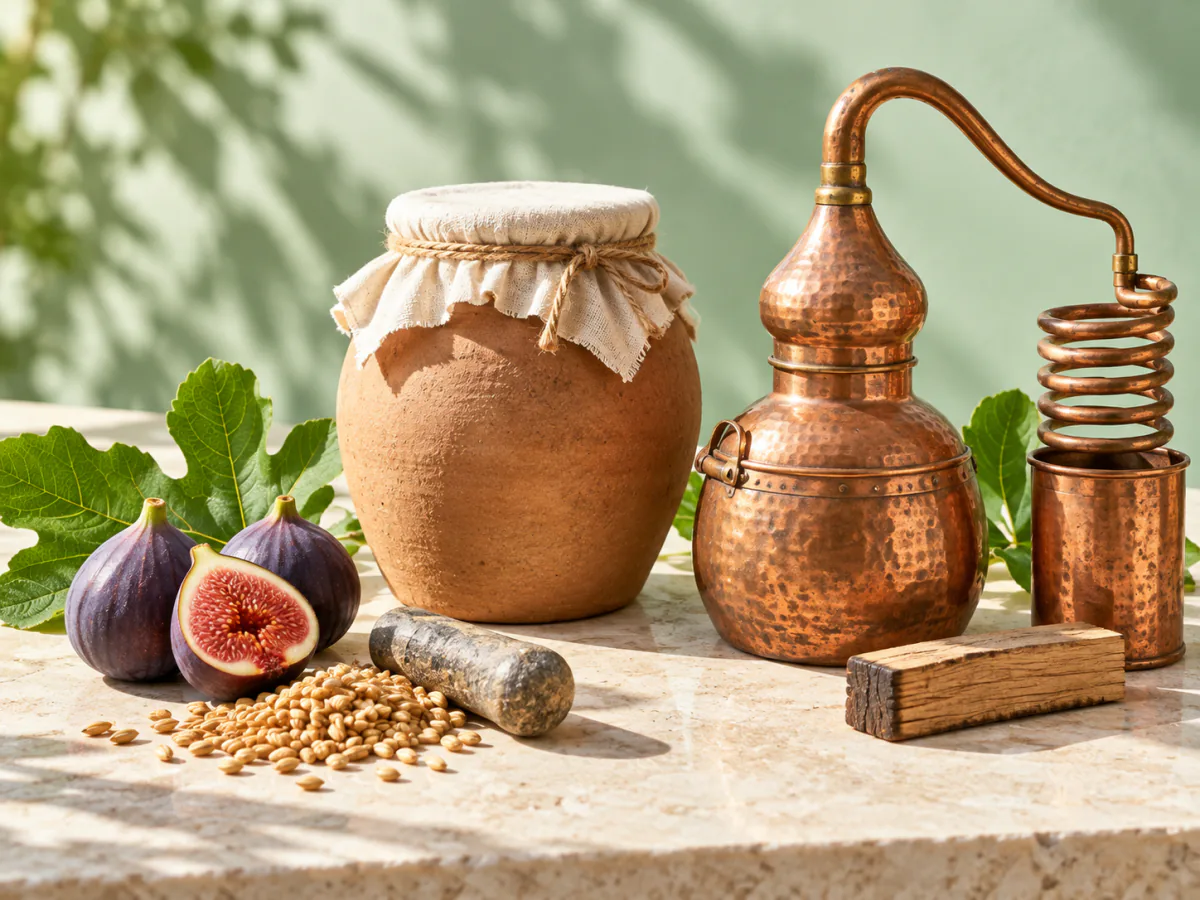
Grain worked in a mortar, a rice-and-honey drink in a jar, then wine in a still: the history of alcohol involves very different ingredients, vessels and techniques. Evidence from Raqefet, Jiahu, Georgia, Armenia and Egypt illuminates several ancient centres of fermentation. Much later, distillation and ageing created other drinks, including cognac.
The evidence takes different forms. Residue analysis tells us about a pottery vessel's contents; a text records a practice; a piece of equipment enables a technical operation. The calibrated years before present (cal BP) used for Raqefet are also distinct from dates BCE. Alongside this material history, primate studies explore dietary exposure to ethanol on a much older timescale.
Raqefet Cave: an early fermented grain drink
A 2018 study of three stone mortars at Raqefet Cave, Israel, describes cereal-based beer brewing by Natufian hunter-gatherers. The archaeological contexts date to 13,700–11,700 calibrated years before present (cal BP). The authors discuss malted wheat or barley, plant processing and a probable link to ritual feasting.
Cal BP is a radiocarbon convention, rather than an equivalent of BCE. The evidence supports an early fermented grain beverage and a plausible ritual context. It does not prove this was the first alcohol made or that beer caused the later domestication of cereals.
Jiahu: a mixed fermented beverage in China
Chemical analysis of pottery from Jiahu identified a beverage made from rice, honey and fruit. The vessels belong to an Early Neolithic sequence, with the relevant period around 7000–6600 BCE. The paper presents direct evidence of a fermented beverage, while noting that alcohol itself is volatile and was not preserved directly in the pottery fragments.
Ingredients, residues and archaeological context support fermentation, but do not preserve a modern measurement of alcohol content or justify calling the drink a “cocktail” in today's sense.
Georgia and Areni-1: two kinds of wine evidence
A study published in PNAS identified chemical traces consistent with grape wine at Gadachrili Gora and Shulaveris Gora in Georgia, dating to around 6000–5800 BCE. This is early biomolecular evidence for grape wine and viticulture. The findings at these sites are more precise than a claim that Georgia was wine's sole birthplace.
At Areni-1 in Armenia, excavation and chemical analysis support wine production around 4000 cal BCE. The study detected evidence related to malvidin in two ancient samples and interpreted the installations as strongly consistent with wine production. That does not require claiming that every part of a modern winery, every grape variety or every ritual was passed down uninterrupted from this site.
Predynastic Egypt and Mesopotamian texts
At Hierakonpolis, Egypt, radiocarbon dating of brewery residues gives a calibrated period of 3764–3537 BCE at a two-sigma interval. Chemical and botanical analyses identify cereal-based beer, and the study estimates that approximately 325 litres could have been produced in one episode. This describes a production event, rather than a daily output.
The Hymn to Ninkasi is a Sumerian literary text preserved in Old Babylonian copies from around 1800 BCE. The Oxford Electronic Text Corpus translation describes beer bread and brewing imagery. A literary text records how beer was represented and remembered; it is not a laboratory recipe with a validated alcohol content.
From fermentation to distillation: a different technique
Fermentation and distillation do different jobs. In a fermented drink, yeasts turn sugars into alcohol. Distillation comes afterwards: it separates and concentrates constituents of an already alcoholic liquid. It does not create alcohol by simply heating water or fruit.
A still combines a boiler, a path for vapour and a cooling system. The liquid is heated, the vapours are directed through the apparatus, then condensed to collect a distillate. Alcohol and other constituents do not all pass through in the same way: choosing which fractions to collect helps shape the spirit's profile.
This opens a different world from the fermentation jar. Equipment, heating and cuts become elements of the product. The distiller works with wine or another fermented base, so the base's origin and the way it was fermented remain important to aroma.
The history of these devices runs through several texts and technical traditions, including alchemy, medicine and perfumery. It requires distinguishing the age of an apparatus, the distillation of any liquid and its use for beverages. Attributing the invention of every spirit to one person, century or region would flatten those stages into a single story.
Cognac: from wine trading to aged spirit
In the Charentes region of France, the development of wine spirits was linked to maritime wine trading. The history presented by the Bureau National Interprofessionnel du Cognac places Dutch merchants' role in distilling Charentais wines in the 16th century, followed by the development of double distillation in the 17th century. These are stages in cognac's history, rather than the birth dates of all distillation.
The Charentais technique shows what the apparatus adds. A first distillation of wine produces brouillis, which is distilled a second time. The distiller then selects the desired fractions. The copper still, the management of the heating and these cuts contribute to the spirit's character.
Time in a cask brings another transformation. Wood, time and exchanges during ageing change the distillate's profile. The craft of making cognac thus brings together vine growing, winemaking, distillation, ageing and trade.
A modern spirit is therefore more than an ancient drink made stronger. It depends on raw material, equipment, skills and an organised production process. Cognac provides a documented example here; whisky and rum have their own histories.
ADH4 and the evolutionary hypothesis
Carrigan and colleagues reconstructed ancestral primate ADH4 enzymes in a laboratory. Their results suggest that an ancestor of great apes, near the transition towards a more terrestrial way of life around 10 million years ago, had an enzyme better adapted to ethanol metabolism than earlier tree-dwelling ancestors. This supports an evolutionary hypothesis about dietary ethanol exposure; it is not direct proof of a particular fermented fruit, deliberate drinking or a human “alcohol gene”.
A 2025 Science Advances study measured ripe fruit from 20 species at chimpanzee sites in Uganda and Côte d'Ivoire. Estimates weighted by feeding time reached approximately 0.32% ethanol by weight at Ngogo and 0.31% at Taï. Using published estimates of feeding rates, the authors calculated around 13.6–15.0 g of ethanol a day for the chimpanzees studied. These are modelled population-level intake estimates, rather than blood-alcohol levels. They should not be converted into a human serving: body mass, metabolism, diet and standard-drink definitions differ.
Another 2025 paper in Current Biology documents wild chimpanzees in Guinea-Bissau repeatedly eating and sharing naturally fermented African breadfruit, with ethanol confirmed in the fruit. For a related field report, see our article on the chimpanzee study. The observation is intriguing, but does not prove that ethanol caused sharing, created human drinking rituals or gave the fruit a universal social function.
A chronology with the evidence kept visible
- 13,700–11,700 cal BP: cereal-based beer brewing reported at Raqefet Cave, Israel.
- Around 7000–6600 BCE: mixed fermented rice, honey and fruit beverage at Jiahu, China.
- Around 6000–5800 BCE: biomolecular evidence for grape wine at Gadachrili Gora and Shulaveris Gora, Georgia.
- Around 4000 cal BCE: installations and chemical evidence consistent with wine production at Areni-1, Armenia.
- 3764–3537 cal BCE: dated brewery residues at Hierakonpolis, Egypt.
- Around 1800 BCE: Old Babylonian copies of the Hymn to Ninkasi.
- 16th–17th centuries: development of Charentais wine distillation and double distillation in cognac's history, linked to maritime trade.
On a very different timescale, the reconstructed ADH4 change dates to approximately 10 million years ago: an evolutionary inference, rather than an archaeological beverage date.
This list ranks neither cultures nor products. It sets different kinds of evidence alongside one another: residue chemistry, radiocarbon dating, texts, enzyme reconstruction and field observation.
Ancient fermented drinks tell several stories of grain, fruit, vessels and communities. Stills and then casks add other skills: concentrating, selecting and allowing a drink to develop. The passage from beer and wine to spirits is a technical transformation as well as a history of trade and taste.
Research into ancestral ethanol metabolism opens another timescale again. It prescribes no contemporary drinking habit. What runs through this history is the ability to transform a raw material and give the resulting drink a particular place in life.