Zero Pulse
Grapes that still whisper, even without alcohol

By Anthony
To begin
The non-alcoholic wine market is booming, driven by a thirst for sobriety, well-being, and inclusivity. Lower in calories and free from side effects—yet still festive—these drinks are winning over an ever-growing number of consumers, from the curious to the connoisseur. But behind this alcohol-free revolution, a key question often remains: what happens to a wine’s identity when the alcohol is gone? Can we still speak of varietal character, food pairings, or terroir? The answer lies in the grape variety itself. For while non-alcoholic wine has changed its image, it has not abandoned its roots.
The grape variety: the aromatic compass of non-alcoholic wine
Removing alcohol from a wine means removing far more than just a percentage figure on the label: it means stripping away a fundamental carrier of aromas, texture, and length on the palate. Despite technical advances, dealcoholisation always results in a partial loss of aroma and texture. In this context, the choice of grape variety becomes a crucial factor. Certain grape varieties —naturally expressive, rich in primary aromas, and possessing fine acidity —make it possible to compensate for the loss of alcohol with a degree of elegance. Conversely, other varieties— more subtle or sensitive to structural changes —struggle to deliver a satisfying tasting experience once dealcoholised.
The choice of grape variety is all the more strategic given that dealcoholisation technologies are not neutral: reverse osmosis, vacuum distillation, and evaporation all alter the wine’s organoleptic profile to varying degrees. Consequently, only grape varieties capable of withstanding these processes —while retaining freshness, aromatic intensity, and balance —allow for the production of high-quality dealcoholised wine. The vine, therefore, does more than simply supply the raw material for non-alcoholic wine; it defines its sensory profile.
Grapes that hit the right note without the intoxication
Not all grape varieties handle the dealcoholisation process with the same flair. Some hold their own, adapt, or even truly shine. These are the varieties that now make it possible to create balanced, aromatic, and appealing non-alcoholic wines. A look at the most promising ones, by colour.
For whites ⚪, freshness takes centre stage
Chardonnay reigns supreme. Its full-bodied, fruity, and sometimes oaky profile holds up well after dealcoholisation, especially when it has benefited from careful ageing. The result is round, balanced wines that sometimes recall classic Chardonnays from temperate climates.
Sauvignon Blanc, lively and intense, is another excellent choice. Its aromas of citrus, tropical fruit, and vegetal notes resonate vibrantly in the dealcoholised versions, which retain a lovely crispness.
As for Muscat, it acts as an aromatic wildcard. Its explosive profile of lychee, fresh grapes, and white flowers helps mask any potential loss of complexity caused by the dealcoholisation process.
Riesling, a more niche yet promising variety, offers lovely mineral and citrusy tension. It retains excellent natural freshness, a highly sought-after quality in premium non-alcoholic white wines.
For reds 🔴, the challenge lies in achieving fruitiness without astringency.
Merlot stands out thanks to its supple tannins and generous cherry and blackcurrant aromas. It yields accessible, luscious alcohol-free reds with good aromatic persistence.
Cabernet Sauvignon, being more structured, can sometimes lose its balance, yet it remains an interesting choice for those seeking depth. When the tannins are well-managed, it adds body and fine complexity.
Pinot Noir, for its part, presents a real challenge. Its delicate tannins and aromatic finesse can be compromised by dealcoholisation, sometimes resulting in a profile that is too flat. It requires highly precise winemaking to fully express its potential without alcohol.
For rosés 🟣, lightness takes centre stage
When it comes to rosés, grape varieties such as Grenache and Cinsault stand out. Low in tannins and highly fruit-forward, they produce light, fresh wines with notes of small red berries —perfect for convivial summer gatherings. They handle dealcoholisation well while retaining the roundness and freshness that are hallmarks of the rosé style.
From grape varieties to the plate, non-alcoholic wine is finding its place at the table.
While alcohol is often associated with warmth on the palate and length, it is not the sole factor dictating food pairings. In non-alcoholic wine, it is the grape varieties—through their aromatic signatures —that guide the pairings. The result is a diversity of styles and food-and-wine combinations just as broad—and sometimes even bolder—than those found with traditional wine.
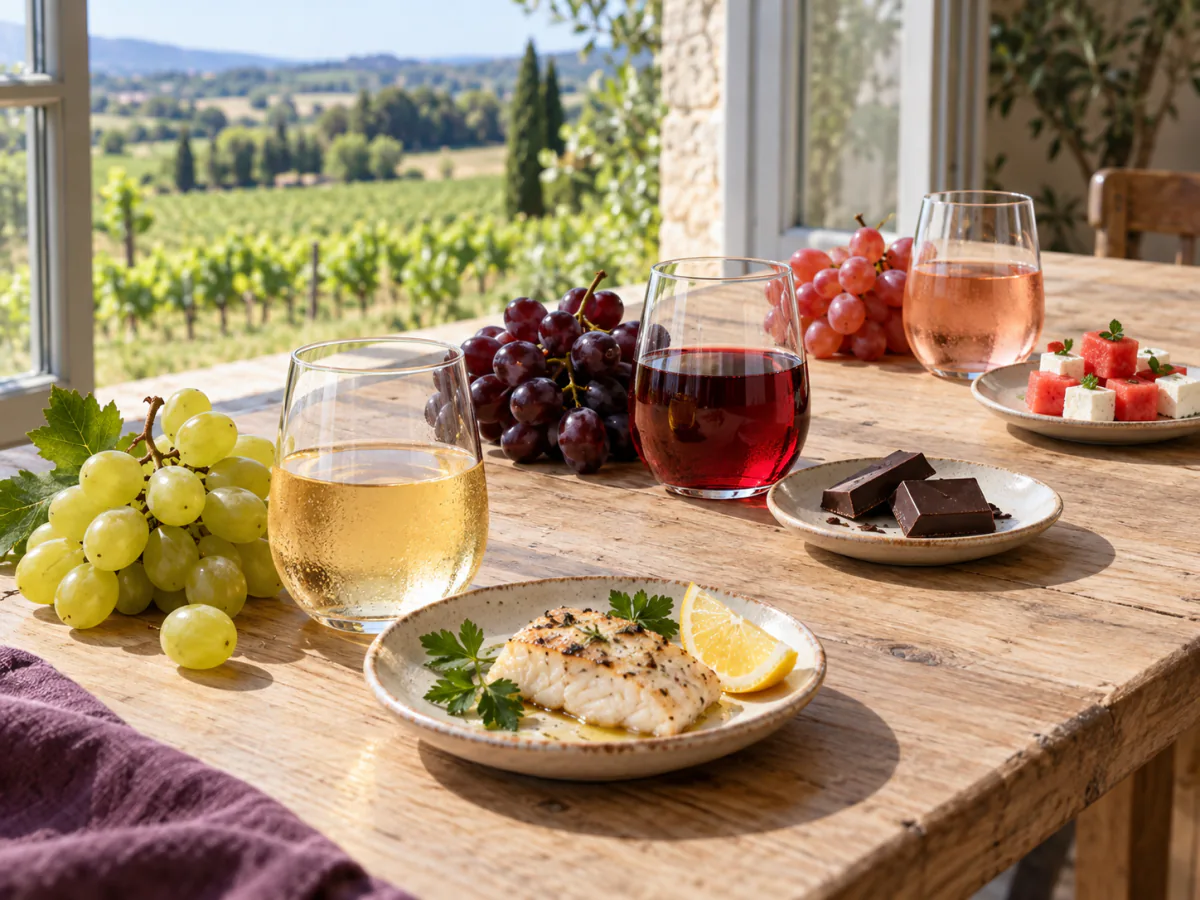
De-alcoholized whites, dominated by Chardonnay, Sauvignon Blanc, or Muscat, reveal profiles that are both fresh and rich. They pair naturally with seafood, fresh cheeses, summer salads, or fruity desserts. A lightly oaked non-alcoholic Chardonnay, for instance, goes beautifully with cod fillet or apricot tart.
As for reds, Merlot and Cabernet Sauvignon offer fleshy, spicy expressions, ideal for enhancing stews, grilled red meats, or aged cheeses. A non-alcoholic Merlot can also surprise when paired with a dark chocolate dessert, playing on the sweet-bitter contrast.
Non-alcoholic rosés, made from Grenache or Cinsault, shine thanks to their lightness and freshness. They pair effortlessly with grilled dishes, tapas, or even a watermelon and feta salad. Their liveliness also makes them perfect for summer aperitifs.
In short, non-alcoholic wines retain genuine pairing potential, thanks to the grape varieties selected and their ability to express clear, distinct aromas. They are table wines in the noble sense of the term: they complement the food without ever overpowering it.
Can a wine still be wine without alcohol?
It is a troubling question—one that sometimes even divides enthusiasts: can a beverage still be called "wine" once the alcohol—an element so central to the tasting experience—has been removed? While the French regulatory framework remains vague on this point, many producers are taking a decisive stance: they are banking on grape quality and the rigorous selection of grape varieties to establish a genuine flavour identity.
It is a bold, somewhat uncertain gamble. After all, without alcohol, the texture changes, the warmth vanishes, and the finish on the palate is muted. Yet, typicity —a wine’s ability to reflect its grape variety, terroir, and winemaking process —can endure, provided the groundwork is laid carefully. The choice of grape variety thus becomes a statement of intent: to make non-alcoholic wine a product in its own right, rather than merely a watered-down alternative.
This quest for legitimacy is also driven by evolving consumer expectations. Less attached to traditional oenological rituals but still attuned to aromas, authenticity, and complexity, consumers are embracing dealcoholised wines that tell a story—of a grape variety, a style, or a moment. In short, non-alcoholic wine does not seek to imitate its traditional counterpart, but rather to forge its own path—distinctive and authentic.
Non-alcoholic wine does not betray the vine; instead, it pays tribute to it in a different way. By selecting the most expressive grape varieties—those best suited to dealcoholisation—winemakers are reinventing a beverage that retains the nobility of its origins. Rich aromatic profiles, perfectly balanced freshness, and preserved structure—all these elements contribute to a sensory experience that, while distinct from traditional wine, holds its own in any comparison.
Drawing on a diversity of grape varieties, non-alcoholic wine is gradually establishing its own unique identity. Less a mere alternative than a style in its own right, it now takes its place at the table—whether for an aperitif or a gourmet meal—bringing with it new conventions while maintaining uncompromising standards. And if you truly listen to what it has to say, you might well find that this wine is far from lacking a soul.